Colorado Springs sits at the foot of Pikes Peak, an hour south of Denver, and most visitors come for the red rocks of the Garden of the Gods and a ride to the summit. Yet this is where a teacher on a mountaintop wrote the words of "America the Beautiful", where a railway climbs higher than any other rack railway in the world, where a family gave away its most beautiful land on condition that it stay free forever, where people with tuberculosis came to breathe and get well, and where a misdialled phone call started a Christmas tradition followed by millions.
This is Colorado Springs's bright side, in roughly the order it happened. Some of its favourite stories have grown in the telling, and we say so where they have. Every chapter ends with something you can go and see.
1820: The First Ascent of Pikes Peak
The mountain is named after Zebulon Pike, who saw it in November 1806 and tried to climb it, but turned back in deep snow and never reached the top. The first recorded ascent was made on 15 July 1820 by the botanist Edwin James, a member of Stephen Long's expedition. The summit area was made a National Historic Landmark in 1961.
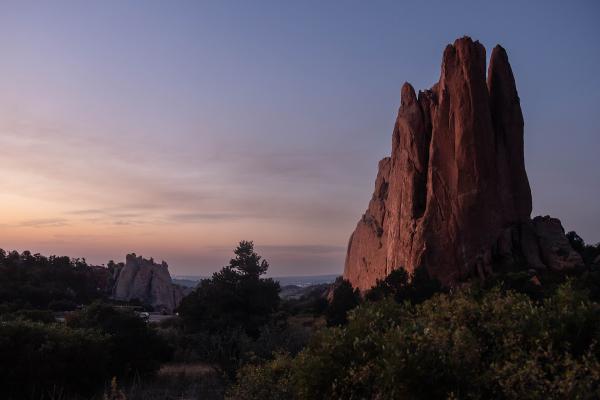
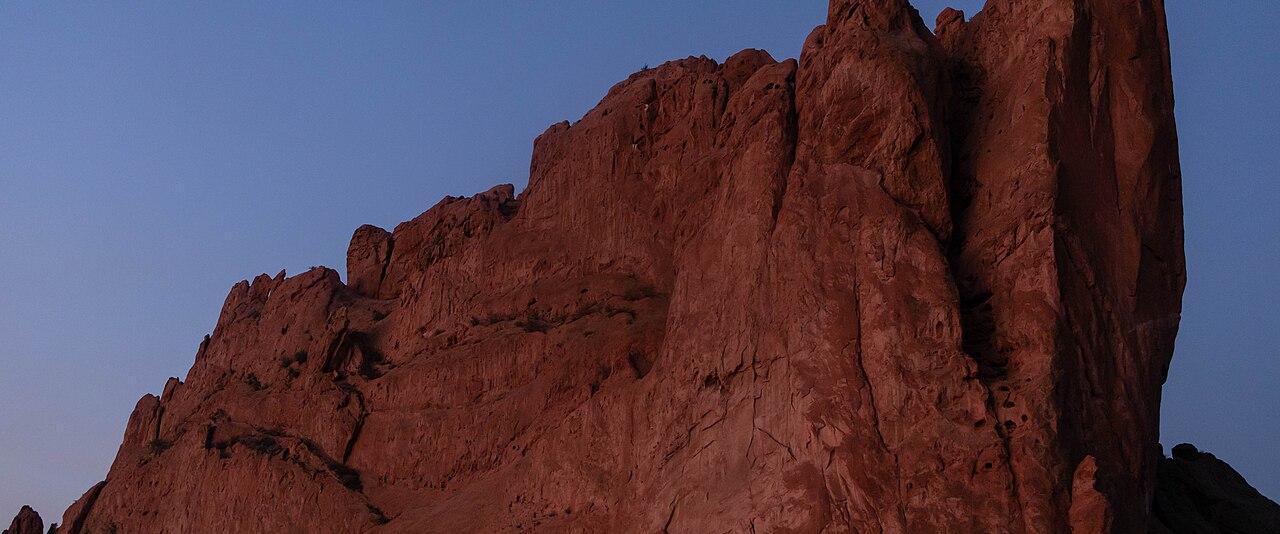
 Pikes Peak beyond the red rocks of the Garden of the Gods. Image: Ian Baldwin, CC0, via Wikimedia Commons.
Where to see it today: the summit, 14,115 feet as signed, can be reached by the cog railway, by car on the Pikes Peak Highway, or on foot on the Barr Trail from Manitou Springs, a long day's climb of about 7,800 feet.
1871: Palmer's Town
On 31 July 1871 the railway builder William Jackson Palmer founded the Fountain Colony, renamed Colorado Springs the same year. A Quaker who had won the Medal of Honor in the Civil War, he planned a town without saloons and, over the next decades, gave it about 1,270 acres of parks, among them Monument Valley Park, Palmer Park and North Cheyenne Cañon, plus land for schools, churches and hospitals. He also gave land and money to the Colorado School for the Deaf and Blind and helped found Colorado College, chartered in 1874.
 The 1929 equestrian statue of William Jackson Palmer at Nevada and Platte Avenues. Image: David Shankbone, CC BY-SA 3.0, via Wikimedia Commons.
Where to see it today: walk or cycle the paths of Monument Valley Park along Monument Creek, then visit the Colorado College campus north of downtown, where Cutler Hall, the first building, still stands. Palmer's bronze statue of 1929 is at the crossing of Nevada and Platte Avenues; the popular story that his horse was called Diablo is a myth.
 Cutler Hall, the first building of Colorado College. Image: Lumen Wilde, CC BY 2.0, via Wikimedia Commons.
 Monument Valley Park, one of the parks Palmer gave the city. Image: ForgottenColorado, CC BY-SA 4.0, via Wikimedia Commons.
1880s to 1960s: The Health Seekers
Dry air, sunshine and altitude brought thousands of people with tuberculosis to Colorado Springs; in the 1880s and 1890s perhaps a third or more of the residents had come for their health. Sanatoriums opened around the town, and some of the patients stayed, recovered and built its institutions.
 An advertisement for the Cragmor Sanatorium from 1906. Image: Not named., Public domain, via Wikimedia Commons.
The Cragmor Sanatorium, opened around 1905–06 with Palmer's support and nicknamed the "Sun Palace", treated patients until antibiotics made such places unnecessary. In 1964 it was sold to the University of Colorado for $1, and the university's Colorado Springs campus began there the next year. The Union Printers Home, opened by the typographers' union in 1892, cared for its sick and old members for more than a century.
 Main Hall at UCCS, the former Cragmor Sanatorium. Image: Xnatedawgx, CC BY-SA 3.0, via Wikimedia Commons.
Where to see it today: the sanatorium building is now Main Hall of the University of Colorado Colorado Springs, 1420 Austin Bluffs Parkway, on an open campus. The Union Printers Home, at 101 South Union Boulevard, can be seen from outside. The Pioneers Museum tells the health-seekers' story.
1891: The Cog Railway
On 30 June 1891 the first train of the Manitou and Pikes Peak Railway reached the summit. The line is 8.9 miles long and climbs from 6,320 feet at the depot in Manitou Springs to 14,115 feet, on grades of up to 25 percent. The engineering society ASME lists it as the highest rack railway in the world and the highest railway in the United States.
 A train crossing the timber line on the Pikes Peak railway, around 1900. Image: , Public domain, via Wikimedia Commons.
The line closed in 2017 for a rebuild of about $100 million, with new trains and track, and reopened on 20 May 2021.
 The cog railway's trains at the summit of Pikes Peak. Image: Han Zheng, CC BY-SA 2.0, via Wikimedia Commons.
Where to see it today: trains leave from the depot at 515 Ruxton Avenue, Manitou Springs; the round trip takes about three hours. Book ahead in summer.
22 July 1893: "America the Beautiful"
Katharine Lee Bates, an English professor from Wellesley College, came to Colorado Springs in the summer of 1893 to teach at a summer school held at Colorado College. On 22 July she went up Pikes Peak with a group of teachers, first by prairie wagon and then by mule for the last stretch. At the top, looking over the plains, she began a poem she first called "Pikes Peak".
It was published as "America" on 4 July 1895, revised in 1904 and finalised in 1913. Set to Samuel Ward's tune "Materna", written for a different hymn in 1882, it became "America the Beautiful", one of the best-loved songs in the country.
Where to see it today: a bronze plaque with the poem has stood on the summit since 1993. The new Summit Visitor Center, opened in 2021, has exhibits on the mountain and its history. The plaque is near the summit; ask the staff where it stands now.
1909: Free Forever
In 1879 the Chicago railway executive Charles Elliott Perkins bought land among the red rocks north-west of town. He wished it to become a public park but died in 1907 before he could arrange it. In 1909 his children gave the land to the city, on condition that it remain free to the public forever, with no alcohol sold and almost no buildings put up.
 The plaque recording the gift of the Garden of the Gods, on North Gateway Rock. Image: Beatrice Murch from Buenos Aires, Argentina, CC BY 2.0, via Wikimedia Commons.
The Garden of the Gods became a National Natural Landmark in 1971 and now covers about 1,340 acres. More than a century later it is still free.
Where to see it today: the park is open from 5 a.m. to 10 p.m. in summer and to 9 p.m. in winter. The plaque is on North Gateway Rock, near the main parking area. The Visitor and Nature Center, 1805 North 30th Street, is also free.
1899: Tesla's Laboratory
In May 1899 Nikola Tesla came to Colorado Springs to build an experimental laboratory on the plain east of town, with free power from the local electric company and funding from John Jacob Astor IV. Until January 1900 he worked there on high-voltage discharges and wireless transmission, producing artificial lightning. Many stories grew around those months, of sparks jumping from taps and of town lights lit without wires; most are anecdotes, and the famous photograph of Tesla sitting calmly beneath giant arcs was a double exposure made for effect.
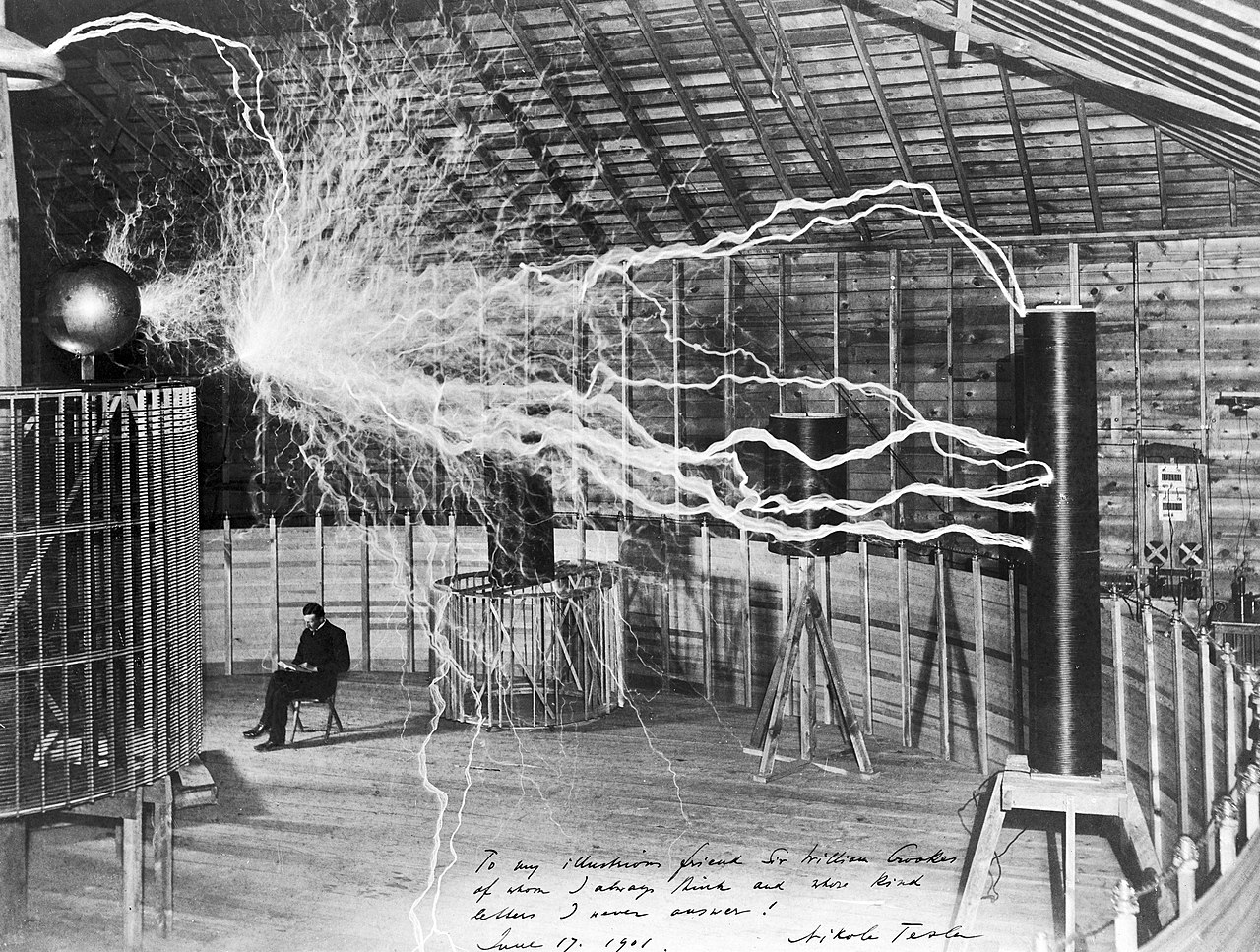 Tesla in his Colorado Springs laboratory: a double exposure made for effect in 1899. Image: , Public domain, via Wikimedia Commons.
Where to see it today: the laboratory was torn down in 1904 and the site, near Kiowa Street and Foote Avenue, is now houses. A plaque about Tesla is in nearby Memorial Park.
 The exterior of Tesla's laboratory in 1899. Image: Charles Alley, photographer, Public domain, via Wikimedia Commons.
1915 to 1937: Penrose's Mountain
The mining millionaire Spencer Penrose built the Pikes Peak Highway in 1915, and in 1916 started the Pikes Peak International Hill Climb to promote it; its organisers call it America's second-oldest motor race, after the Indianapolis 500. In 1918 he opened The Broadmoor hotel, and in 1926 he founded the Cheyenne Mountain Zoo, at 6,714 feet the highest zoo in the country by its own reckoning. In 1937 he and his wife Julie set up the El Pomar Foundation, which still gives grants across Colorado.
 A 1956 race car from the Pikes Peak Hill Climb, which has been run since 1916. Image: Dick Thompson from Albuquerque NM, USA, CC BY-SA 2.0, via Wikimedia Commons.
The zoo is a non-profit without local tax support. It has bred more than 200 giraffe calves since 1954, and visitors can feed the herd by hand.
 The giraffe herd at the Cheyenne Mountain Zoo. Image: Nonoesimposible, CC0, via Wikimedia Commons.
Where to see it today: the Cheyenne Mountain Zoo, 4250 Cheyenne Mountain Zoo Road, is open daily. Above it is the Will Rogers Shrine of the Sun, built by the Penroses in 1937 and named for the humorist who died while it was being built; the Penroses are buried in its chapel. The Hill Climb is held every June.
 The Will Rogers Shrine of the Sun above the zoo. Image: Frank Winkelmann, CC BY 3.0, via Wikimedia Commons.
1955: Tracking Santa
In December 1955 a Sears advertisement in the local newspaper gave a phone number for children to call Santa. A child misdialled and reached the operations centre of the Continental Air Defense Command at Ent Air Force Base. The officer on duty, Colonel Harry Shoup, played along. Staff drew Santa's sleigh on the tracking board, a press officer told the papers, and the tradition stuck. The popular version, in which a misprint flooded the line with calls, grew in later retellings; contemporary accounts suggest it was one child.
 Colonel Harry Shoup, "the Santa Colonel". Image: Air Force - NORAD file photo, Public domain, via Wikimedia Commons.
NORAD Tracks Santa has run every Christmas Eve since; 2025 was its 70th year. More than a thousand volunteers now answer the phones at Peterson Space Force Base, and Shoup's gravestone reads "Santa Colonel".
Where to see it today: Cheyenne Mountain and the bases are not open to the public. On 24 December, call or follow the tracker online like everyone else.
1956: Up and Down the Mountain
On 10 August 1956 a doctor organised a race up Pikes Peak to prove a point about smoking: 13 runners started, and none of the three smokers finished. The Pikes Peak Marathon has been run ever since, up and back from Manitou Springs, with the shorter Ascent to the summit. Arlene Pieper's finish in 1959 is often called the first by a woman in an official US marathon; the claim comes from race sources.
Where to see it today: both races are held in August, starting in Manitou Springs on Ruxton Avenue. The Barr Trail they follow is open to hikers all year.
1978: Olympic City
In 1978 the United States Olympic Committee moved its headquarters from New York to Colorado Springs and opened its training centre on the old Ent Air Force Base. The US Olympic & Paralympic Museum opened on 30 July 2020, designed by Diller Scofidio + Renfro so that every visitor follows the same continuous ramp, with no stairs, whether walking or in a wheelchair. The city has called itself Olympic City USA since 2016.
 The US Olympic & Paralympic Museum, opened in 2020. Image: Lumen Wilde, CC BY 2.0, via Wikimedia Commons.
Where to see it today: the museum is at 200 South Sierra Madre Street, open Thursday to Monday from 10 a.m. to 5 p.m. The Olympic & Paralympic Training Center, 1 Olympic Plaza, offers guided tours.
 The museum and the Park Union footbridge at dusk. Image: Lumen Wilde, CC BY 2.0, via Wikimedia Commons.
2012 and 2013: After the Fires
In June 2012 the Waldo Canyon fire burned into the city's Mountain Shadows neighbourhood, destroying 347 homes; more than 32,000 people were evacuated and two died. A year later the Black Forest fire destroyed about 500 more. Residents lined the streets with flags and thank-you signs for the firefighters, a relief fund raised $940,000 from 48 states, and by 2014 more than three-quarters of the lost homes in Mountain Shadows had been rebuilt. The Flying W Ranch, burned in 2012, reopened in 2020.
 A helicopter dropping water on the Waldo Canyon fire in 2012. Image: U.S. Air Force Photo by Master Sgt. Jeremy Lock, Public domain, via Wikimedia Commons.
Where to see it today: the Flying W Ranch serves its chuckwagon suppers again in summer. The Waldo Canyon Trail itself remains closed, so don't plan to hike it.
How to See Bright Colorado Springs
A day around the city. Start early at the Garden of the Gods and the Perkins plaque. Drive up to Manitou Springs for the cog railway to the summit of Pikes Peak. In the afternoon walk through Monument Valley Park to Colorado College, then downtown to the free Pioneers Museum in the old courthouse at 215 South Tejon Street and the Olympic & Paralympic Museum. End at Palmer Park for sunset over the peak.
 Sunset over Pikes Peak from Palmer Park. Image: mark byzewski, CC BY 2.0, via Wikimedia Commons.
Further afield:
- The Cheyenne Mountain Zoo and the Will Rogers Shrine of the Sun.
- Main Hall at UCCS, the former Cragmor Sanatorium.
- The Pikes Peak Highway, 19 miles to the summit.
Dates to know:
- June: the Pikes Peak International Hill Climb.
- August: the Pikes Peak Ascent and Marathon.
- 24 December: NORAD Tracks Santa.