
What Garden of the Gods Is
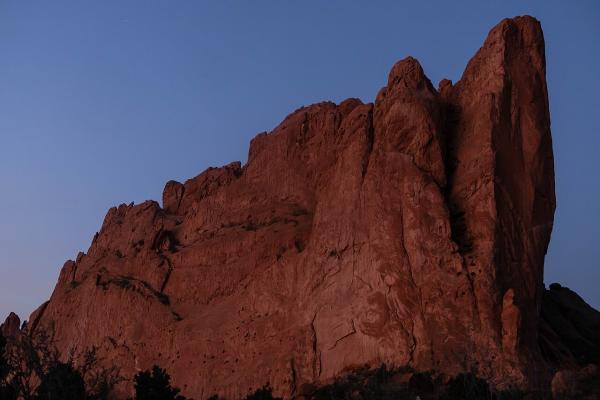
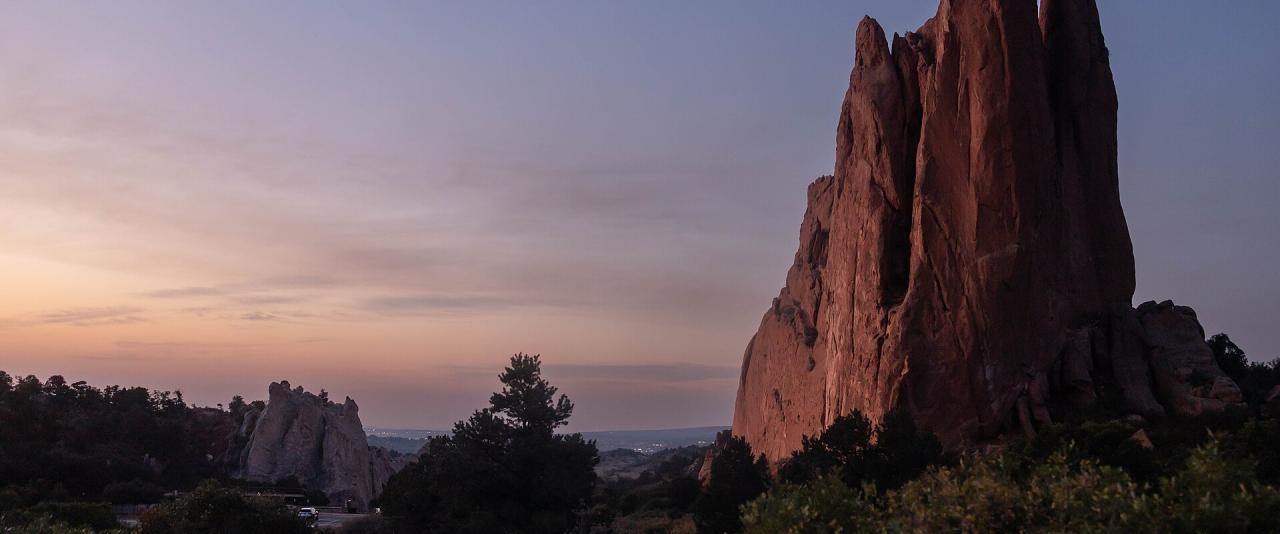
Garden of the Gods is a free public park on the west side of Colorado Springs, where tilted fins of red, pink and white sandstone rise abruptly from the plains with Pikes Peak behind them. The rocks are sedimentary layers, mainly from the Lyons and Fountain formations, that were laid down flat over millions of years and then pushed up nearly vertical when the Rocky Mountains rose. Erosion has since cut them into the ridges and balanced boulders you see today.
The land was owned by railroad executive Charles Elliott Perkins, who wanted it kept open to the public. After his death in 1907, his children gave it to the City of Colorado Springs in 1909 on the condition that it would always remain free. It was later designated a National Natural Landmark. Entry, parking and the trails are all free.
The Main Formations
Most of the famous formations sit in the Central Garden, the area inside the park's main loop road.
- North and South Gateway Rocks are the two tallest fins, facing each other across the central trail. They frame the classic photograph of Pikes Peak through the gap.
- Kissing Camels is a formation on top of North Gateway Rock that looks like two camels touching noses; ask at the visitor center for the best viewing spots.
- Three Graces and the Cathedral Spires are tall, thin pinnacles near the south end of the Central Garden.
- Balanced Rock, near the park's southern edge on the road toward Manitou Springs, is a large boulder perched on a narrow base. A short path leads from the parking area for close-up photos.
- Siamese Twins is a double formation with a natural window that frames Pikes Peak, reached by a short loop trail in the southwest part of the park.
The Trails
The park has a network of trails, but most visitors stick to a handful.
The Perkins Central Garden Trail is the main route, a paved loop of about one and a half miles that runs between Gateway Rocks and the other central formations. It is wheelchair- and stroller-accessible and has interpretive signs about the geology and history. Start from the main parking lot on the north side of the Central Garden; if it is full, a shuttle from the Visitor & Nature Center has operated on busy days.
The Siamese Twins Trail is a short, unpaved loop of under a mile with a modest climb to the formation and its window view.
For a longer walk away from the crowds, the unpaved Palmer Trail links with other trails to make loops of a few miles, with views back across the formations. Pick up a trail map at the visitor center, as the unpaved network has many junctions.
Stay on marked trails. The rock is soft and crumbles easily, off-trail walking damages the vegetation, and rescues of hikers who scramble up the formations happen regularly. Technical climbing is allowed only with a free permit from the city and proper equipment; unroped scrambling above a low height is prohibited.
When to Go
The light is best in the first hour or two after sunrise, when the low sun hits the east-facing rock and Pikes Peak behind it, and again in late afternoon. Early morning is also when the park is quietest; by mid-morning on summer weekends the main parking lot fills and traffic on the loop road slows.
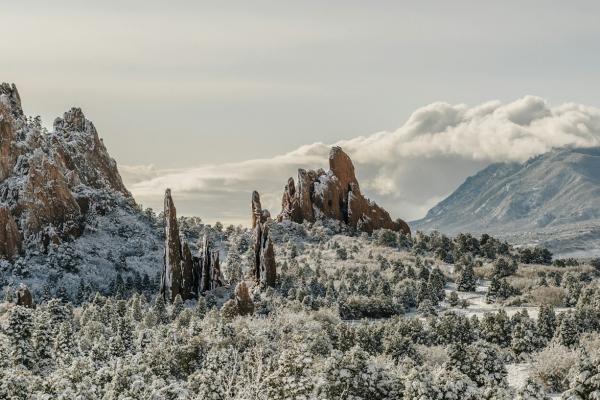
Summer days are hot on the exposed trails, and afternoon thunderstorms are common from July to August. Spring and autumn are the most comfortable seasons. Winter visits can be good on clear days, as the red rock shows up well against snow, but trails can be icy in shaded spots.
The park has longer hours in summer than in winter; check current opening times on the city's website.
What to Bring
There is very little shade on most of the trails, and the elevation is over 6,000 feet, so take sun seriously:
- At least a liter of water per person, more in summer
- Sunscreen, a hat and sunglasses
- Sturdy shoes for the unpaved trails, which have loose gravel and some steep sections
- A light layer, as wind picks up in the afternoons and temperatures drop quickly after sunset
Combining Your Visit
Start at the Garden of the Gods Visitor & Nature Center on 30th Street, across from the park's east side. It has exhibits on the park's geology, plants and wildlife, and the terrace is one of the best viewpoints over the formations. From there, you can drive through the park and continue to Manitou Springs, a short drive west, for lunch, the town's mineral springs and the base station of the Pikes Peak Cog Railway.