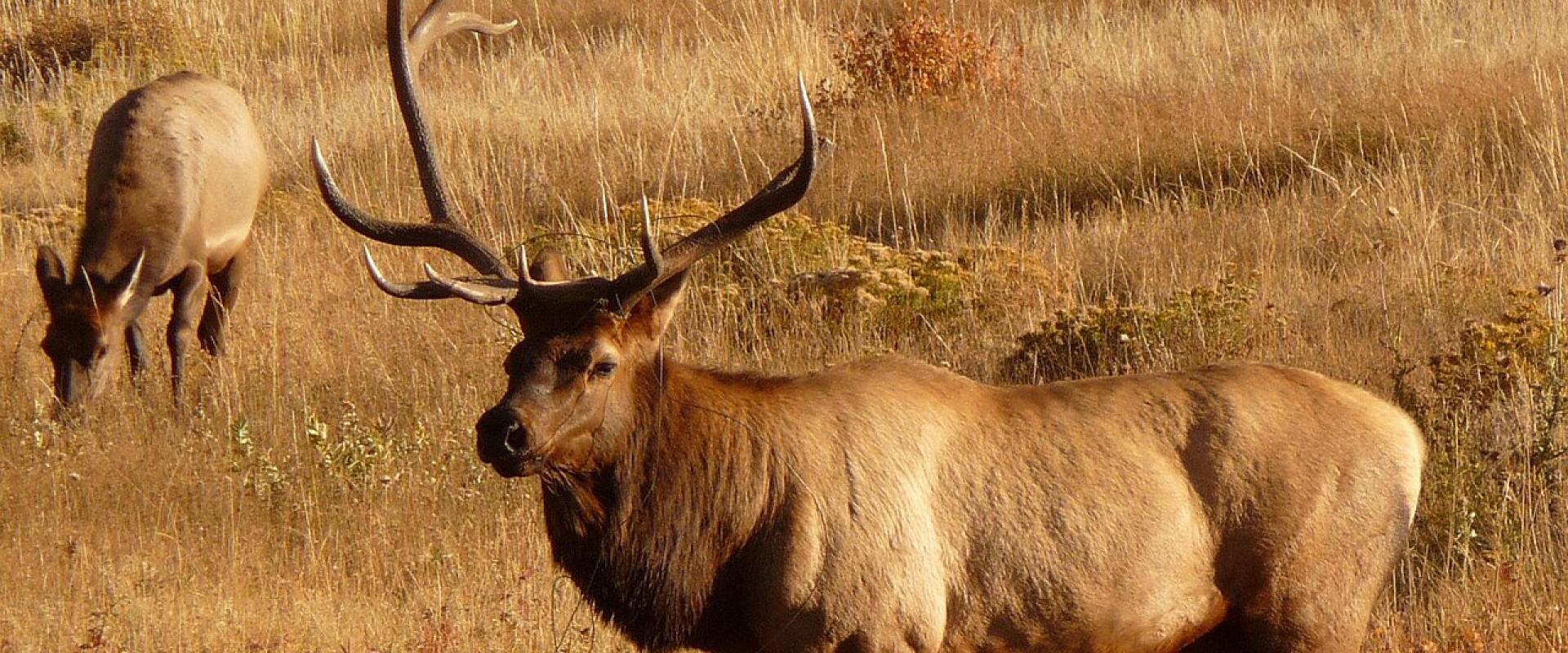
Colorado's best wildlife watching follows a calendar: elk bugling in Rocky Mountain National Park in September and October, sandhill cranes in the San Luis Valley in March and again in early autumn, bald eagles around Denver's lakes in winter, and moose in North Park and the Kawuneeche Valley for most of the year. Go at dawn or dusk, bring binoculars, and keep your distance. Several of the best spots have closures and rules that rangers enforce.
Elk rut in Rocky Mountain National Park
Every autumn, bull elk gather harems in the meadows on the park's east side, and their bugling carries across the valleys at first and last light. The rut is the park's biggest wildlife event, and the meadows near Estes Park get busy with cars and long lenses.
The park runs the same meadow closures every year. In 2025 they ran from September 1 through October 31, from 5 p.m. to 10 a.m. daily, in Horseshoe Park, Moraine Park, Upper Beaver Meadows, Harbison Meadow and Holzwarth Meadow. During those hours you can't walk or ride a horse off the roads and designated trails. Fishing is also closed from 5 p.m. to 7 a.m. on stretches of the Fall River, Big Thompson River and Colorado River that you'd reach through the closed meadows. Check the park's news page in late August for the current year's notice.
Two more rules apply across the park: calling elk is prohibited, and so is using spotlights or vehicle headlights to look for wildlife. The park asks visitors to stay at least 75 feet (23 m) from elk, roughly the length of two school buses. The park warns that bull elk can be aggressive during the rut.
How to do it well: arrive before sunrise or stay until dusk, park only in marked pullouts and lots, and watch from beside your car. Moraine Park and Horseshoe Park are the classic viewing meadows. On the west side, Harbison and Holzwarth meadows near Grand Lake are usually quieter.
Bighorn sheep
The Rocky Mountain bighorn is Colorado's state mammal, and Colorado Parks and Wildlife (CPW) estimates the statewide population at about 7,000.
- Sheep Lakes, Rocky Mountain National Park. Bighorns come down to a natural mineral lick in Horseshoe Park in late spring and summer. To protect them, the park closes Horseshoe Park and the West Alluvial Fan to off-trail foot travel from April 15 to August 31. Stopping or parking in the posted Bighorn Crossing Zone is also prohibited unless park staff direct traffic.
- Georgetown. CPW calls the Georgetown herd, 250 to 350 animals, one of the largest in the state. There's a viewing station with binocular signs near Georgetown Lake, just off I-70. Use it instead of pulling over on the interstate. Early to mid-morning is often productive. The town and CPW traditionally hold a Bighorn Sheep Festival on the second Saturday in November, with volunteers and spotting scopes at the viewing station. Confirm the date before you drive up.
Moose: North Park and the Kawuneeche Valley
Moose weren't historically widespread in Colorado. The state introduced four bulls and eight cows into North Park in the 1970s, and they did well there. CPW now calls North Park, the high basin around Walden, the moose-viewing capital of Colorado, with more than 600 moose seen year-round. State Forest State Park, along North Park's eastern edge on Highway 14, has a Moose Visitor Center that CPW opened in 1997. Ask there where moose have been seen lately. A Colorado State Parks pass is required.
In Rocky Mountain National Park, the first moose was recorded in 1980 in the Kawuneeche Valley on the west side, near Grand Lake. They stayed mostly on the west side until about 2011–2012, and the park now reports moose in all of its watersheds. Your best chance is still the willow flats along the Colorado River in the Kawuneeche Valley, in the early morning.
Moose are the animal people most often underestimate. CPW has repeatedly warned about cows defending calves, and the attacks it has flagged usually involve dogs, because a moose treats a dog as a predator. Keep dogs leashed. If a moose lays its ears back, paws the ground, licks its snout or turns to face you, you're too close: back away and give it room. Trying to scare a moose off a trail counts as harassment, which is illegal.
Bald eagles near Denver in winter
You don't need to go far from Denver to see bald eagles.
- Barr Lake State Park, northeast of Denver. CPW says numerous bald eagles winter at the lake and one pair stays to nest every year. The southern half of the park is a wildlife refuge with viewing stations and a nature center. CPW points to February as an excellent month, with nesting pairs plus wintering birds. A state parks pass is required.
- Rocky Mountain Arsenal National Wildlife Refuge, in Commerce City. According to the U.S. Fish and Wildlife Service, migrating bald eagles roost in big cottonwoods along the lake edges in winter, so scan the trees toward evening as they come in to roost. The refuge's Wildlife Drive also runs through a fenced bison pasture. Stay in your vehicle there.
Sandhill cranes in the San Luis Valley
This is Colorado's most spectacular bird event. The U.S. Fish and Wildlife Service estimates the Rocky Mountain population of sandhill cranes at 18,000 to 21,000 birds, and about 95% of them stop in the San Luis Valley in spring and fall to feed. In spring they arrive from mid-February and usually peak in early March. In fall they arrive in mid-September, peak in early October and leave by mid-November.
The Monte Vista Crane Festival is the time to go if you like guided tours and talks. The 43rd festival ran March 6–8, 2026, and the 44th is set for March 5–7, 2027, based at Monte Vista National Wildlife Refuge (6120 S. Highway 15, Monte Vista). Watching the cranes costs nothing: the refuges stay open throughout the festival. A Festival Pass covers talks and films, and field trips need a separate ticket. Go at sunrise, when the cranes lift off from their roosts, or at sunset, when they fly back in.
Wildlife-watching rules that keep you safe
- Distance: at least 75 feet from elk and bighorn sheep, more from moose. If an animal changes its behaviour because of you, you're too close.
- Don't feed anything. That includes chipmunks at overlooks.
- Dogs: keep them leashed, and leave them home when you're going to moose country.
- Driving: pull fully off the road in a marked pullout. Don't stop in a traffic lane because others have.
- Light and noise: no spotlights in the national park, no elk calls, and keep your voice down at dawn.
- Bears: in black bear country, use the bear-proof bins and lockers provided and never leave food in a car or tent.
When to go: a quick calendar
| Season | What to watch | Where |
|---|---|---|
| Winter (Dec–Feb) | Bald eagles, bighorn sheep | Barr Lake, Rocky Mountain Arsenal, Georgetown |
| Early spring (Feb–Mar) | Sandhill cranes | Monte Vista NWR, San Luis Valley |
| Late spring–summer | Bighorns at the mineral lick, moose with calves | Sheep Lakes, State Forest SP, Kawuneeche Valley |
| Autumn (Sep–Oct) | Elk rut, cranes return | RMNP meadows, San Luis Valley |
| November | Bighorn Sheep Festival | Georgetown viewing station |