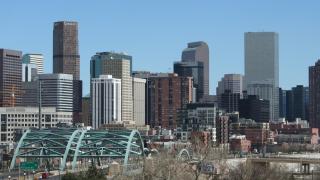
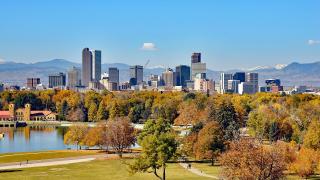
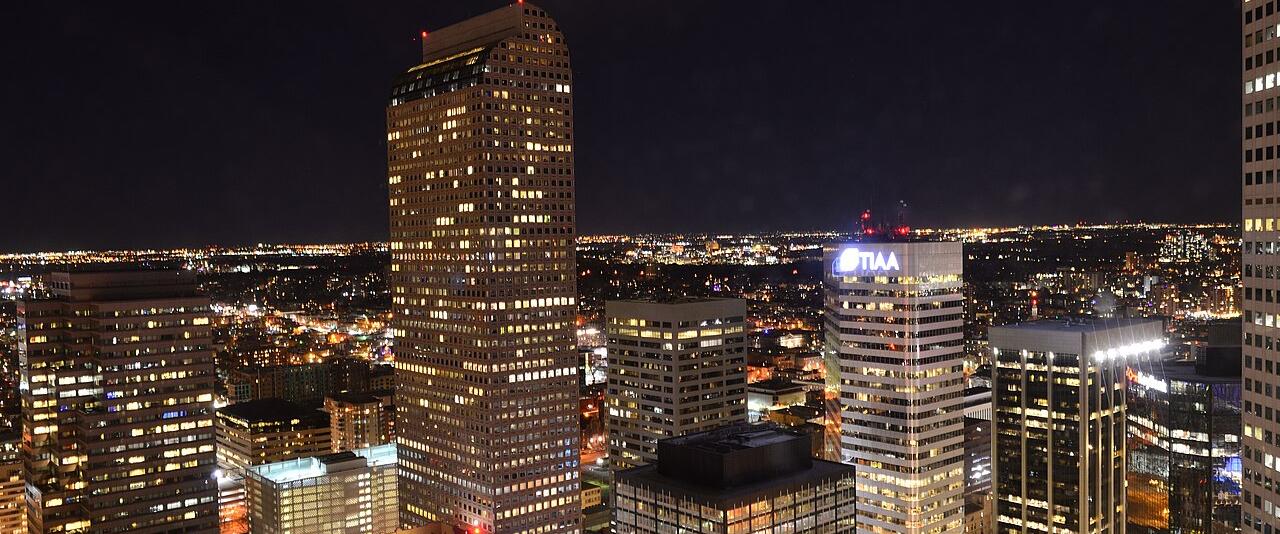
Denver is the Mile High City: three hundred days of sunshine, craft breweries, the Rockies filling the western sky. It began as a gold-rush camp where crowds watched hangings by Cherry Creek, and it grew up fast and hard. Its soldiers rode out to massacre a peaceful Cheyenne and Arapaho village, its mob burned Chinatown, its contractors chopped up the dead to clear a cemetery for a park, and in the 1920s its mayor and governor answered to the Ku Klux Klan.
Most of these chapters left something behind you can still find: a plaque on a downtown corner where a whistleblower was shot, a mural for a Chinese laundry worker, a pavilion on top of a graveyard. This guide goes through them in order, from 1859 to the present, and tells you where to see each one.
1859–1860: Hangings by Cherry Creek
Denver was founded in 1858 in the Pike's Peak gold rush, before there was any legal government to speak of. Its first settlers made their own justice in "people's courts". On 9 April 1859 a man named John Stoefel, convicted of murdering his brother-in-law, was hanged from a cottonwood tree near Cherry Creek in front of about 1,000 people. In October 1860 James Gordon, who had shot a man in a saloon and fled to Kansas, was brought back, tried by another people's court and hanged before several thousand spectators.
Where to see it today: there is no marker. The banks of Cherry Creek, now lined with a bike path, run through the heart of the city.
 Denver after the Cherry Creek flood of May 1864. Image: Miscellaneous Items in High Demand, PPOC, Library of Congress, Public domain, via Wikimedia Commons.
On the night of 19–20 May 1864, Cherry Creek itself turned on the town. A flash flood killed about 20 people and swept away the offices of the Rocky Mountain News, which had been built on stilts in the creek bed, along with many of the city's early records.
1864: Sand Creek
In June 1864 a settler family, the Hungates, were murdered on a ranch about 25 miles southeast of Denver. No one was ever charged, but their bodies were displayed in the town, and fear and anger at the Plains tribes spread. That summer the territorial governor, John Evans, called for volunteers to fight "hostile Indians", and the 3rd Colorado Cavalry was formed, with its headquarters in Denver.
 An 1864 recruiting poster for the 100-day volunteers of the Colorado cavalry. Image: The Weekly Register-Call, Central City, Colorado, Public domain, via Wikimedia Commons.
At dawn on 29 November 1864, about 675 soldiers under Colonel John Chivington attacked a camp of Cheyenne and Arapaho people at Sand Creek, in southeastern Colorado, who believed they were under the army's protection. About 150 people were killed, most of them women, children and the elderly. When the soldiers returned to Denver, body parts taken from the dead were displayed at a theatre and in saloons.
Not every soldier took part. Captain Silas Soule ordered his men not to fire and later testified against Chivington. On 23 April 1865, he was shot dead on a Denver street. His killer was never tried.
 Captain Silas Soule, who refused to fire at Sand Creek and was murdered in Denver in 1865. Image: Denver Public Library, Public domain, via Wikimedia Commons.
Where to see it today:
- A plaque at 15th and Arapahoe Streets, downtown, marks where Silas Soule was shot.
- The Colorado State Capitol. Its Civil War soldier statue once listed Sand Creek among the territory's "battles"; it was pulled down by protesters in 2020, and the state has approved a Sand Creek memorial for the Capitol grounds.
- Mount Blue Sky, the 14,000-foot peak west of the city, was named Mount Evans after the governor until 2023, when it was renamed.
31 October 1880: The Chinatown Riot
By 1880 several hundred Chinese immigrants lived in Denver, most of them in a small Chinatown along Wazee Street. It was an election year, and politicians and newspapers had been stirring up anger at Chinese workers. On 31 October a fight in a saloon at 16th and Wazee turned into a riot. A mob of about 3,000 people destroyed nearly every Chinese home and business. Look Young, a 28-year-old laundry worker, was beaten and dragged through the streets and died. No one was punished, and no one was compensated.
 The anti-Chinese riot in Denver, 31 October 1880, in a contemporary engraving. Image: Miscellaneous Items in High Demand, PPOC, Library of Congress, Public domain, via Wikimedia Commons.
In 2022 the city of Denver formally apologised.
Where to see it today: a mural honouring Look Young and the Chinese community, by Nalye Lor, covers the side of Fire Station 4 at 1890 Lawrence Street, a block from where he was killed. Historical markers stand nearby in LoDo, at 19th and Lawrence and at 1620 Wazee.
1893: The Cemetery Under the Park
Denver's first cemetery, opened in 1858 on a hill east of the town, had become the City Cemetery by the 1870s. In 1890 Congress allowed the city to turn it into a park, and in March 1893 an undertaker named E. P. McGovern was hired to move the remaining graves to Riverside Cemetery, at $1.90 a body. He used child-sized boxes and broke up remains to make them fit, so that he could charge for more coffins. When the Denver Republican exposed "the work of ghouls" a few days later, the mayor cancelled the contract. No one finished the job. Thousands of bodies are believed to remain under the grass.
 The Cheesman Memorial Pavilion, built in 1908 over the old City Cemetery. Image: Knapp.keith, CC BY-SA 3.0, via Wikimedia Commons.
Where to see it today: Cheesman Park, on the east side of Capitol Hill, with its white marble pavilion from 1908. Remains have been found during construction as recently as 2008, at the Denver Botanic Gardens next door.
The Market Street Madams
In the late 19th century, Market Street (first called Holladay Street) was Denver's red-light district, with up to about 1,000 women working there. Its most famous madams were Mattie Silks, who ran houses there for decades, and Jennie Rogers, who built the most elaborate brothel in the city, the House of Mirrors.
 Mattie Silks, the most famous of Denver's Market Street madams. Image: , Public domain, via Wikimedia Commons.
Reformers closed the district in the 1910s.
Where to see it today: the House of Mirrors at 1942 Market Street, built in 1889, still stands; its façade now fronts a bar. Mattie Silks is buried at Fairmount Cemetery under her married name, Martha Ready.
18 December 1922: The Mint Robbery
On the morning of 18 December 1922, gunmen opened fire on a Federal Reserve truck being loaded outside the Denver Mint and escaped with $200,000 in new five-dollar bills. A guard, Charles Linton, was killed. A month later the body of one of the robbers was found frozen in the getaway car in a Denver garage. Part of the money turned up in Minnesota, but no one was ever charged, and in 1934 the police announced that all the gang members were dead.
 The Denver Mint in the early 1900s. Image: Detroit Publishing Co, Public domain, via Wikimedia Commons.
Where to see it today: the Denver Mint, 320 West Colfax Avenue. Free tours run Monday to Thursday and must be booked online in advance.
The 1920s: The Klan's City
In the early 1920s Denver had one of the strongest chapters of the Ku Klux Klan in the country, with tens of thousands of members. Its Grand Dragon, a Denver doctor named John Galen Locke, built a political machine. Benjamin Stapleton, mayor of Denver from 1923, was a Klan member; when the city tried to recall him in 1924, he survived with the Klan's money and promised to work with it "heart and soul". In 1924 Coloradans elected a Klan governor, Clarence Morley, who later went to federal prison for mail fraud.
 Klansmen and a burning cross in Denver, 1921. Image: Denver News, Public domain, via Wikimedia Commons.
The machine collapsed within a few years, but Stapleton served as mayor until 1947, and Denver's airport carried his name from 1944. When the old airport site was redeveloped as a neighbourhood, residents voted in 2020 to drop the name; it is now called Central Park.
Where to see it today: the old Stapleton airport control tower, preserved in Central Park in northeast Denver.
 The control tower of the old Stapleton airport. Image: L.T. Hanlon, CC BY-SA 3.0, via Wikimedia Commons.
1942: The Governor Who Said No
After Pearl Harbor, the US government removed about 120,000 Japanese Americans from the West Coast and held them in camps. Most governors refused to accept them. Colorado's governor, Ralph Carr, said they were Americans and welcomed them: "If you harm them, you must first harm me." The camp built in Colorado, Amache, near Granada in the southeast of the state, held more than 7,000 people at its peak. Carr's stand cost him his career; he lost a Senate race in 1942 and never held office again.
 Governor Ralph Carr, who opposed the mistreatment of Japanese Americans, in 1940. Image: Harris and Ewing, Photographers, Public domain, via Wikimedia Commons.
Where to see it today:
- Sakura Square, at 19th and Larimer, the centre of Denver's Japanese American community after the war, has a bust of Carr.
- The Colorado Supreme Court building, the Ralph L. Carr Judicial Center, is named after him.
- Amache became a National Historic Site in 2022, about 200 miles southeast of Denver.
 The site of the Amache camp near Granada. Image: Coasterlover1994, CC BY-SA 4.0, via Wikimedia Commons.
1 November 1955: Flight 629
On the evening of 1 November 1955, United Air Lines Flight 629 took off from Stapleton airport for Portland and exploded in the air about 11 minutes later, near Longmont. All 44 people on board were killed. The FBI found that a bomb had been placed in the luggage of a passenger, Daisie King, by her son, who wanted her life insurance. He was executed in 1957. A memorial was unveiled at the old Stapleton tower in 2025.
Today's Shadows
- Colfax. East Colfax Avenue is often called "the longest, wickedest street in America". The line is usually credited to Playboy, but no one has found it in the magazine; it is folklore.
- Homelessness and fentanyl. In July 2023 Denver's new mayor declared a homelessness emergency and began moving people from encampments into shelters and housing; the number of people counted sleeping outside has since fallen sharply. Overdose deaths, driven by fentanyl, hit a record in 2023.
How to visit: Colfax is lively and mostly fine, but stay alert late at night, especially around Civic Center and the bus stops.
How to See Dark Denver Respectfully
A self-guided walk, about 5 km. Start at the Colorado State Capitol and walk to the Denver Mint on West Colfax. Head downtown to 15th and Arapahoe for the Silas Soule plaque, then into LoDo for the Chinatown markers at 1620 Wazee and 19th and Lawrence, the mural at Fire Station 4, and Sakura Square. Finish at the House of Mirrors on Market Street.
Further afield:
- Cheesman Park and the Denver Botanic Gardens.
- Fairmount and Riverside cemeteries, where Mattie Silks, John Evans and Colonel Chivington are buried.
- The old Stapleton tower in Central Park.
- Amache and the Sand Creek Massacre National Historic Site, both in southeastern Colorado.
Dates to know:
- 29 November: the anniversary of Sand Creek, marked by a Spiritual Healing Run from the massacre site to Denver.
- 31 October: the anniversary of the 1880 riot.
A few ground rules. Sand Creek is a place of mourning for the Cheyenne and Arapaho; its memorial site asks visitors to stay on the trails. Cheesman Park is a park, but remember what lies beneath it.